Welcome to WP MutliSite Sites. This is your first post. Edit or delete it, then start writing!
Category: Uncategorised
-
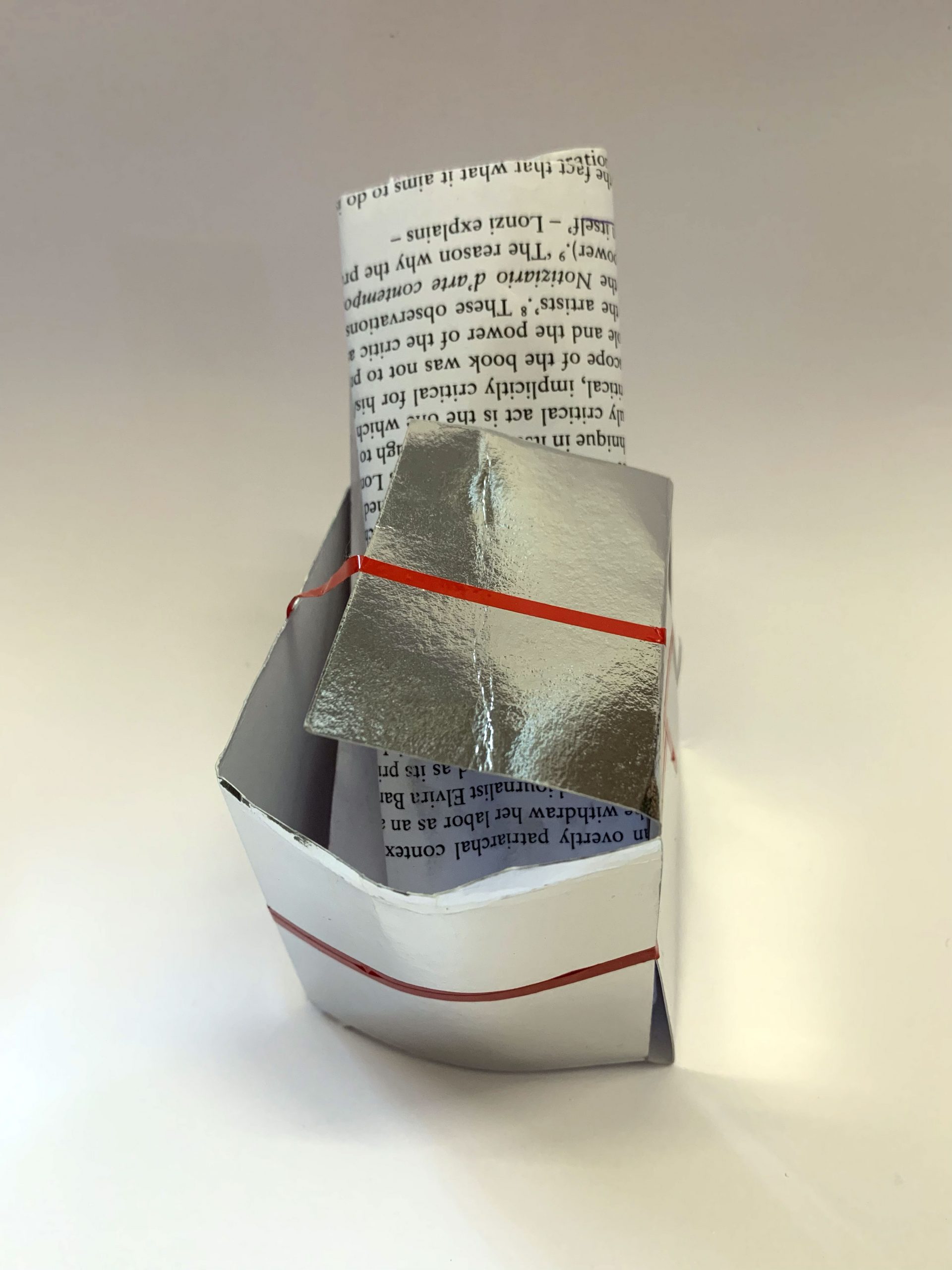
Encounters: Remix, collaborative practice, and co-authorship
The Post-Publishing & ArtSpaceCity research strands of the university’s Centre for Postdigital Cultures held a day-long event exploring the boundaries between the scholarly and the creative. Through a mixture of talks and hands-on practice, they troubled the line between research, literature and performance, investigating co-created, genre-defying, ways of writing, annotation, attribution, presentation, and publication.
The event included talks by Dr Lucia Farinati and Adeola Eze. It asked questions about authorship, how we engage with research material, how we write, and how we might write and annotate collaboratively. One of the key questions is how can working with texts, or interviews with research participants be incorporated into thesis writing in a way that goes beyond simply citing or quoting a work?
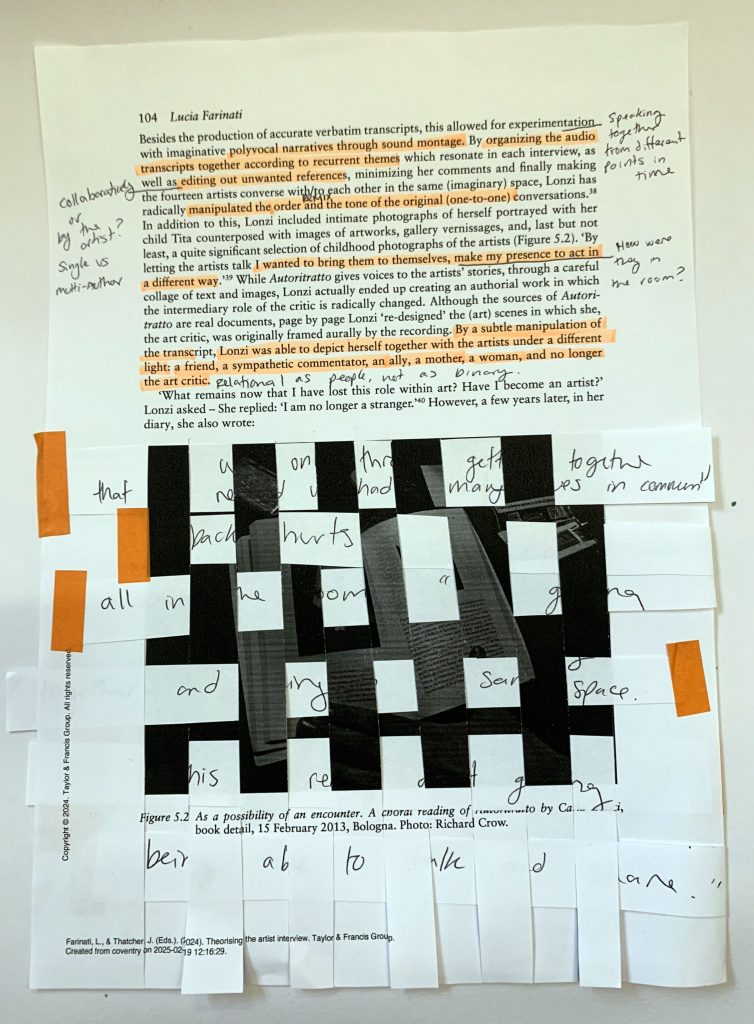
text-sculpture created in the Encounters workshop According to postgraduate researcher Alex Parry:
One of the reasons I was interested in working with colleagues on this subject is that I believe elements of collaborative practice in scholarly work is not discussed enough. I never did any training on how to write notes, annotate or cite others’ work. During my earlier studies, I found that students were expected to know how to write notes on lectures, articles and books. I learned how to work with other people’s texts and ideas by doing it. To me, annotation and working with other people’s text often felt implicit or obscured from view. As annotation was not discussed, it felt private and solitary. In a talk about his research on annotation, Remi Kalir [who Adeola discussed later] reminds us that annotations have a social life beyond the page, whether that is handwritten responses in a book that are read in a bookshop years later, collective annotations in reading groups, or other forms of comment and notation such as in graffiti.
In my artistic practice, I frequently collaborate with others. Collaboration is always a nuanced negotiation, and, like my experience learning to annotate, I have often stumbled through it. Again, the work of collaboration itself has frequently felt somewhat implicit. In my work researching participatory art workshop practices, one artist describes why this might be:
‘in theatre and live art, it is easier to find established methods for collaborative practice,which contrasts with how art practice is often depicted, taught, and enacted as solopractice.’ (Edginton, 2024)
In my experience, collaboration is often tricky. it is not an easy practice. Yet, despite its difficulties and sometimes breakdowns, the demand for negotiation in collaboration fosters a practice of learning to work and think together. It is a continual attempt to orient oneself within and towards collective practice.
Whether working with voices on or off the page, collaborative practice is always a question of power and agency—a means of speaking back, with, or to. Kalir describes the possibility of ‘courageous annotation’ that can support justice-oriented objectives (Kalir, 2020, p. 63). This involves taking risks, being present, and engaging in critique.
As an artist and academic, citation, borrowing, blurring, stealing, and being inspired are inherent in the process. Working with different voices comes in many forms, whether through annotation, quotation, interview practices, writing a paper, or hosting an event or talk like this. Everything is in relation to other beings – be it human or more than human. Within this interconnected network no work is done in isolation.
The organisers are a collective of postgraduate researchers who bring diverse knowledge and practices to the subject.
Clare Harvey – is a novelist researcher. Her practice research looks at how remix can be used as a new way to write biographical fiction. Her claim is that sampling from memoirs and incorporating ‘real’ voices into fiction elevates fictional subjects to the status of co-authors, thereby representing their lives in a more ethical way within the story.
Adeola Eze is with the Centre for Arts, Memory and Communities. Her research explores the significance of book formats from antiquity, prior to the printing press, in deepening our understanding of the relationship between historical contexts and contemporary literature. Adeola Eze is a children’s book author, young writers’ mentor, and publisher. She runs PhD Beyond 50, a blog and community space for mature PhD students, offering support, advice, and reflections on doing doctoral work beyond midlife.
Alexandros Plasatis is a doctoral student at Coventry University’s Centre for Postdigital Cultures. He is the founder, publisher and lead editor of the other side of hope: journeys in refugee and immigrant literature, a literary magazine edited by immigrants and refugees that publishes poetry and prose by migrants from around the world. Established in 2021, the other side of hope receives funding from Arts Council England, and became the UK’s first ever literary magazine of sanctuary. His first book, Made by Sea and Wood, in Darkness, narrates the lives of the undocumented Egyptian migrants who work as fishermen in a Greek town, and was shortlisted for the Edge Hill Prize. Stories from this book have been nominated for the Pushcart Prize and Best of The Net. He has a PhD in ethnography-based Creative Writing.
Alex Parry – I am an artist-researcher conducting practice-led research on the role of participatory art workshops in what is described as the current polycrisis, a global intersection of crises that exceeds the sum of their parts. I explore the participatory art workshop as a space to build association and imagination. As part of my research, I have interviewed artists about their participatory art workshop practices to gain a deeper understanding of how these workshops are often sidelined and considered a secondary art practice and their relevance in the context of wider precarity today.
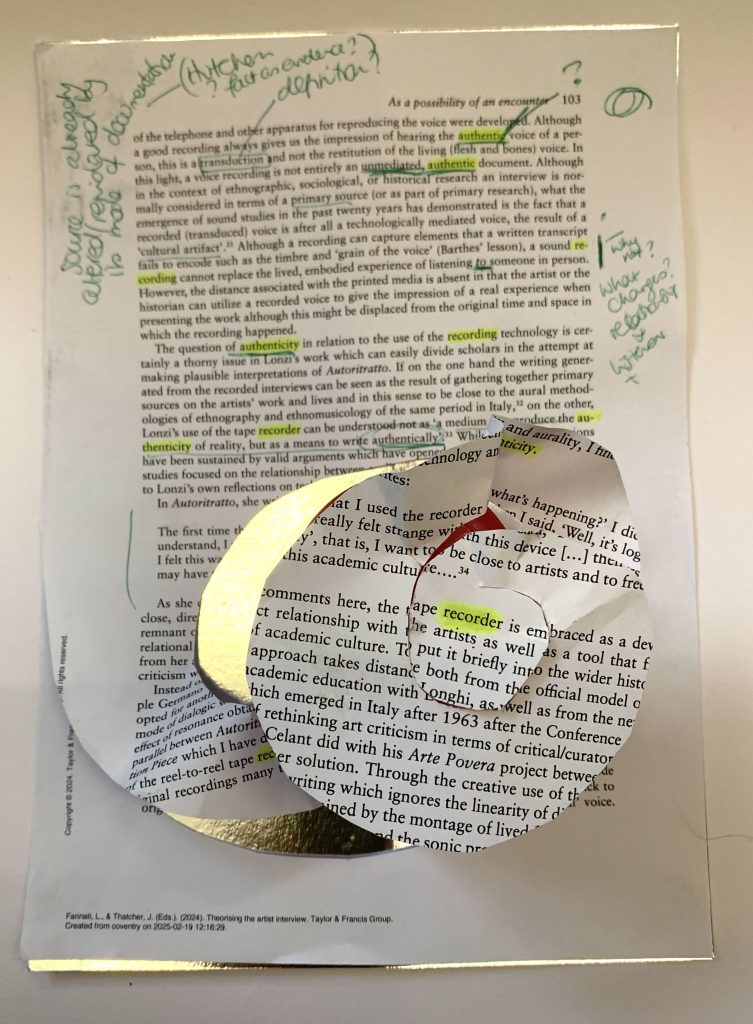
text-sculpture created in the Encounters workshop The order of the day was as follows:
It started with Adeola Eze with Remixing Scholarship – Kathleen Fraser’s Poetic Reworking of the Vindolanda Writing Tablets
This session explored Kathleen Fraser’s m ov a b le TYYPE (2011), a collection that moves beyond conventional poetry into visual experimentation. While Fraser’s earlier work reflects feminist and modernist themes, here she engages with artist books, typography, and the poetic value of ‘errors,’ ‘absences,’ and ‘visual transfusions.’ Adeola focused on Fraser’s poem ‘from The Vindolanda Writing Tablets (Tabulae Vindolandenses III),’ which echoes ancient Roman tablets but is inspired by their 2003 scholarly edition by Alan Bowman and David Thomas. Fraser remixes this material, tracing a path from ancient Roman handwritten text to scholarly edition and to poetic transformation. How does remixing ancient and scholarly texts opens new creative possibilities? How can poetic experimentation reinterpret ancient narratives? How might textual transmission become a site of innovation?
Following this, Clare delivered a writing workshop which used elements from Lucia Farinati’s ‘As a Possibility of an Encounter’ as the stepping off point for a series of micro-writing activities. This was be a playful, practice-based response to some of the ideas Adeola Eze discussed around the transformation of historical records/scholarship into creative work. Using these recombinatory writing games also served as an introduction to Farinati’s work, which was explored through the afternoon’s sessions (for anyone interested in the scholarship that underpins this session, recombinatory writing games fit within the framework of Creative Writing Games for Reading, which use creativity as a motivator for reading scholarly texts; a useful reference point would be Allen Jones’ paper “Open World” Texts: A Framework for Analyzing Recombinatory Writing Games (RWGs))
After lunch, Adeola, Clare and Alex joined forces. This hands-on session focused on their annotation practice – how we annotate and why, as well as how annotation can alter the meaning of a text itself. Whilst focusing on Farinati’s work, they considered how annotation as a practice can not just reinforce authorial meanings, but create new meanings, too.
For the final session of the day, they were fortunate to have Lucia to discuss her text ‘As a Possibility of an Encounter: A Performative Reading of Autoritratto (Self-Portrait) by Carla Lonzi’ (2024). Carla Lonzi’s work, Autoritratto (Self-Portrait), published in 1969, is a constructed text described by Lucia as an ‘imaginary convivium’ (Farinati, 2025: REF). The text brings together interviews Lonzi conducted as an art critic with male artists and one female artist over the course of seven years. Lucia’s article not only examines Carla Lonzi’s innovative approach to interview practices but highlights its significance as an important feminist work and as a creative tool for prefigurative feminist micropolitics. The article thoughtfully reflects on concepts of authenticity and emphasises the roles of recording, listening, transcribing, assembling, and re-performing interviews. This article is part of Theorizing the Artist Interview, a collection edited by Lucia and Jennifer Thatcher, which brings together various approaches to the artist interview.
References
Kiesewetter, Kolb (REF) Annotating Publishing : Publishing as instituent practice
Kalir, J. (2020) “Annotation is first draft thinking”: Educators’ Marginal Notes as Brave Writing. English Journal 110.2 (2020): 62–68
Kalir, J. (2025) Re/Marks on Power How Annotation Inscribes History, Literacy, and Justice. MIT Press.
Lucia Farinati is a writer-researcher, curator and activist. In 2007 she established Sound Threshold, an interdisciplinary curatorial project that explores the relationships between site, sound and text. She has worked with the Precarious Workers Brigade and the Micropolitics Research Group and has collaborated with many sonic art projects and radio initiatives. Her research focuses on dialogic aesthetics, especially on the work of artist William Furlong and the feminist writing of Carla Lonzi which she has activated through collective readings and radio broadcasts. She holds a PhD in Critical Studies from Kingston University, London. She is the co-author of The Force of Listening (2017), Training for Exploitation? Politicising Employability and Reclaiming Education(2017) and co-editor of Theorising the Artist Interview (2025)
-
kinaesthetic heritage
The history that this space holds
The lineages of those who have gathered and danced here before
The lineages of the people I hold in my body
The languages I hold, I cradle,
The tongues in my mouth.L’histoire ensevelie dans cet espace
La lignée de celles et ceux qui, autrefois, se rassemblaient ici et qui dansaient
La lignée de celles et ceux ensevelis dans mon corps
Les langues que je tiens, que je berce,
Les langues dans cette bouche.Les saisons qui passent. Le temps qui passe.
Le printemps avec ses arbres qui bourgeonnent
L’été porté par l’automne, et l’automne par l’hiver,
Puis, de nouveau, le printemps qui fleurit.
Les saisons que je porte,
Les saisons portées par cet espace, par ce corps.A sense of the seasons passing. And time.
How Spring is here in the trees bursting into leaf
How Summer is carried in Autumn
And Autumn in Winter. And then Spring again.
The many seasons I have carried
The many seasons this space, this body, has carried.– April 2025, Studio notes MLC
Kinaesthetic Heritage: bodies, memories, contested heritages, a British Council funded Springboard project is a collaboration between Coventry University (C-DaRE: Marie-Louise Crawley, Heni Hale and Miranda Laurence, and CAMC: Elizabeth Benjamin) and the SFR Création and Performance Lab at the Université Grenoble Alpes (Gretchen Schiller, Lucie Bonnet, Camille Zimmermann). A bilingual, multidisciplinary team embracing dance practice and scholarship, circus, history, critical heritage studies, memory studies and philosophy, we are investigating through practice the role that movement perception plays in uncovering modes of remembering.
Our research is grounded in the 4E approach to cognition (embodied, embedded, enactive and extended, Newen, Gallagher and de Bruin 2018) and aims to expand understandings of the kinaesthetic, through a close focus on a core subtheme of bodies and memory. We ask how movement might mobilise memory differently, and how, through a kinaesthetic lens, we might be able to view history/heritage differently, giving visibility to previously marginalised bodies and stories, and offering innovative methodologies for how we might think through difficult or uncomfortable heritage.
In the current context, these questions are timely and significant: this research approaches a ‘hot topic’ area around moving bodies, memory and contested histories from the perspective of asking how dancers’ expertise of kinaesthetic knowledges might benefit our cultural heritage institutions in (re)reading, (re)viewing and (de)constructing cultural memory through embodied interaction and engagement. Building on recent explorations of ‘ecosystemic’ practice research (Ellis 2023), our thinking is grounded in an investigation of the place of dance practice research within interdisciplinary inquiry and the ramifications of such methodologies for how we might think about memory and history differently.
Spring saw us spending a first week together in the studio at Coventry sharing practice and beginning to build a bilingual English-French ‘lexicon’ for thinking about memory, history and heritage, from, with and through the body. We are now looking forward to our next meeting together in the summer in Grenoble.
– Marie-Louise Crawley, C-DaRE
-
qualitative research in artistic practices
This seminar by José Dias, he shared insights from his practice in jazz performance and ethnography. He observed that artistic research can feel too personal, or conversely like social work. But how to generalise? We need contexts for meaning. Generalising means, ideally, making the research relevant to us all
Inquiry, he said, is a way of questioning the world. Qualitative research can validate your practice, give it structure/framing, and allows you to communicate in different ways.
‘Quality’ in qualitative research is not, therefore, meant in a hierarchical sense. He discussed specific methods he uses, such as discourse analysis, and dialogic ethnography, which studies cultural, emotional, social meanings. Socially, these are negotiating meanings
Autoethnography, on the other hand is about, ‘Why is this important to me?’
Why Does This Matter for PhD students?
The PhD, by definition, is an original contribution to universal academic knowledge. In artistic practice, this includes:
• Creative process as inquiry
• Artworks as research outcomes
• Contextual, reflective, and critical analysis
Qualitative research provides a language to frame and validate practice, and tools to investigate, question, and communicate meaning. In artistic practice, it is an approach to knowledge through:
• Subjective, contextual, lived experience
• Critical reflection on process
• Exploration of cultural, emotional, social meaning
It combines making, thinking, writing, reflecting.
Key Characteristics are an emphasis on:
• Exploration over measurement
• Process over product
• Meaning over proof
It supports deep engagement with materials, contexts, and concepts.
Common Qualitative Methods:
• Autoethnography (your story as data)
• Interviews / dialogic ethnography (collaboration & context)
• Fieldwork & observation (immersive research)
• Documentation (notes, sketches, process videos)
• Embodied inquiry (movement, sound, gesture)
These methods are not separate from practice—they are often embedded in it.
Practice-Based vs. Practice-Led research:
• Practice-Based:
- The artwork is the contribution to knowledge
- Supported by critical reflection
• Practice-Led:
- The research leads to insights that inform or are informed by practice
- Art is a method, not just an outcome
It all must, he said, start with a research question. This can (should) emerge from your practice. It must present a new angle into your ongoing research, and should go beyond your personal inner exploration.
What Are You Really Investigating?
• What questions do I return to in my practice?
• What am I trying to understand through making?
• How does my work speak to broader cultural, philosophical, or political issues?
Outcomes in Artistic Research
• Artworks (installations, performances, scores, etc.)
• Documentation (photos, videos, rehearsal logs)
• Reflections (studio journals, essays, exegesis)
• Contextual writing (thesis, conference papers)
Aligning Artistic Research with the Frascati Manual
The OECD Frascati Manual defines research as:
“Creative and systematic work undertaken to increase the stock of knowledge…”
Artistic research can align with this by ensuring:
– Originality: the project makes a novel contribution to knowledge
– Creativity: artistic methods are valid forms of inquiry
– Systematic Approach: clear research questions and methods
– Transparency: documented processes and reflection
– Transferability: insights extend beyond the artwork itself
Include a written component explaining the research context
Frame your practice as a rigorous, knowledge-producing process
Five Concepts of Artistic Research (Gerard VILAR 2018)
A controversial tendency is now clear: the blurring of differences between art and sciences, arguing that art is a path to knowledge production that is equally as legitimate as the traditional sciences. But is that a good strategy in the skirmishes to gain more legitimacy in the space of academic institutions of higher education and get access to funding? And, is it true that artistic research is comparable to or homologous with scientific research in the field of experimental, social or human sciences and that herein lays the cognitive value of art? Is “artistic research” a sign of submission to the new cognitive capitalism? (Moulier-Butang, 2012).
Five Concepts of Artistic Research (Gerard VILAR 2018)
• Research and production
• The artist as a social researcher
• Curator as researcher
• Research as Disturbances of Reason
• Research as exploration of the Great Outside
Resources
Knowles, J. G., and Ardra L. Cole, Handbook of the Arts in Qualitative Research: Perspectives, Methodologies, Examples, and Issues. Thousand Oaks, CA: SAGE Publications, Inc., 2008. https://doi.org/10.4135/9781452226545
Biggs, Michael and Henrik Karlsson. The Routledge Companion to Research in the Arts. (2010)
Marsh, Julie. “Site-integrity: An embedded and embodied approach to practice-based research.” Scene (2023)
Vilar, Gerard. “Does Artistic Research Produce Knowledge? A Five-Fold Distinction.” (2018)
-
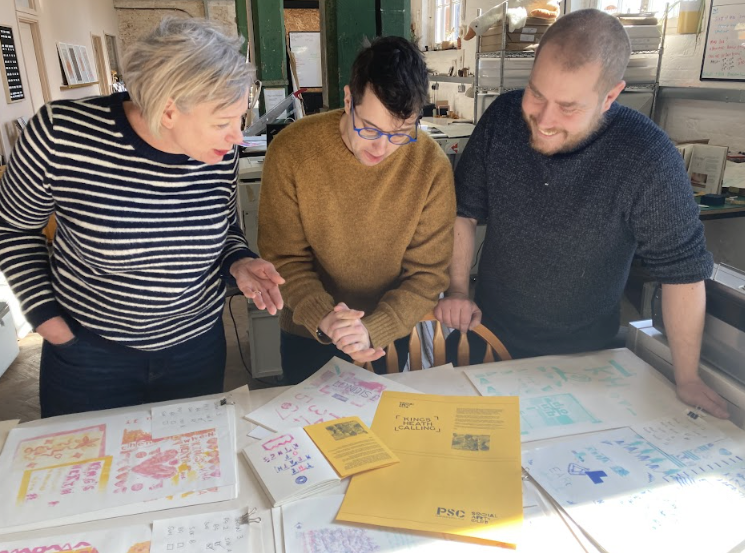
Kings Heath calling: A printed collection of zines
Artist-researchers Mel Jordan (Coventry University), Andy Hewitt (University of Northampton), and Michael Wright (Middlesex University) collaborated with Kings Heath residents to create zines capturing hopes and ideas for their local area. These have now been compiled into a book published by Northampton-based Silly Gooze and launched in April 2025. Working alongside the West Northants Community Safety and Engagement Team, the project combined free workshops and conversations to exchange ideas and perspectives about Kings Heath, identifying areas for practice-based research interventions focused on community development and infrastructural change. The book documents personal reflections and collective aspirations, emphasising the vital role of community voices in shaping local futures.
In May 2025, Hewitt, Jordan, and Wright will return to Kings Heath with People are Publishing, a new project that will generate a community-stitched banner while also exploring how online communities connected to Kings Heath express their shared histories and hopes.
-
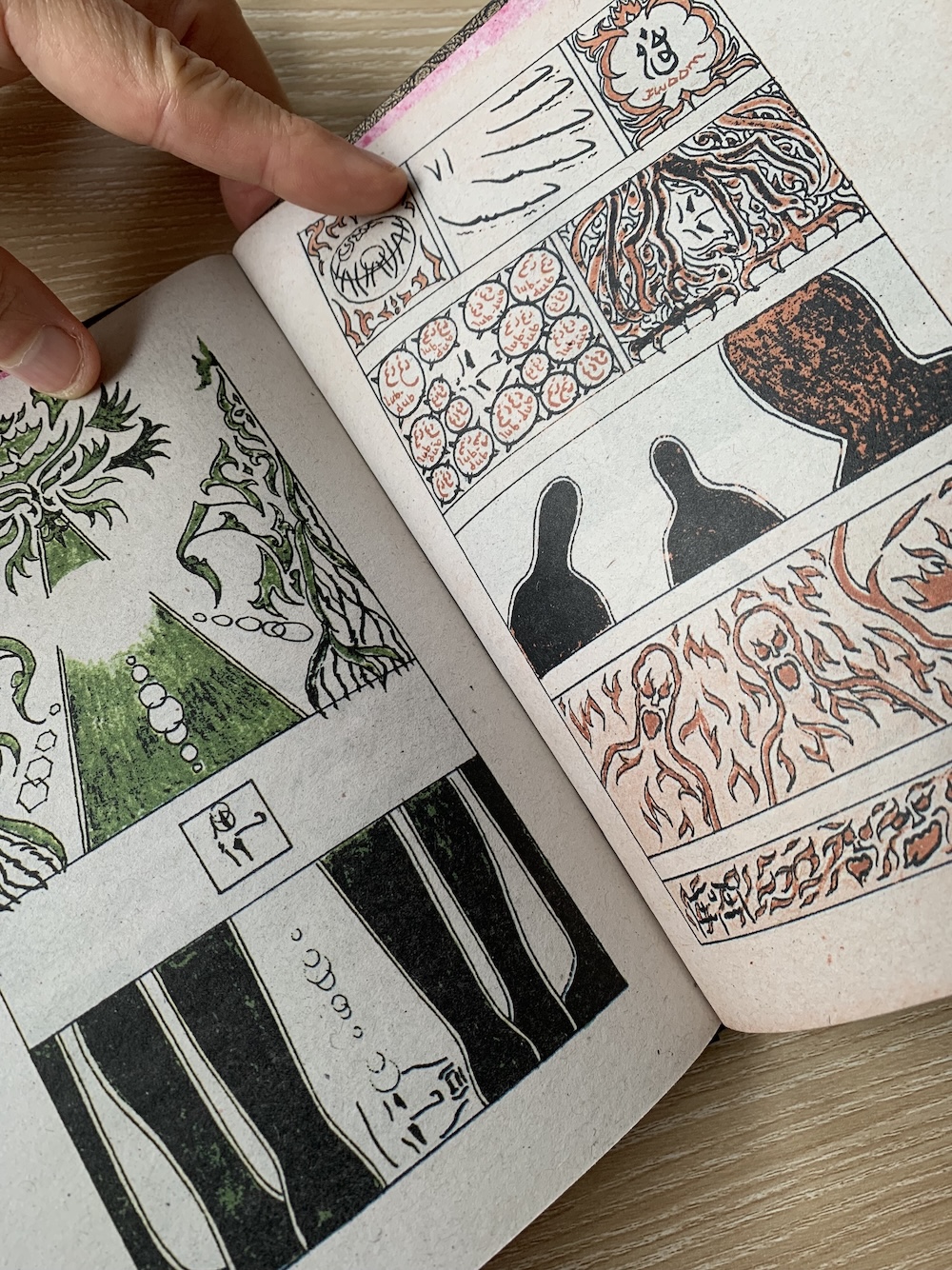
documentation/exposition 2025
Photo: graphic novel created for Riar Rizaldi: Mirage exhibition
We started with a basic definition of research: as defined by UK research councils: ‘A process of investigation leading to new insights, effectively shared’. Breaking this down: a process (as well as product) of research; investigation = methods; new insights – in the PhD, an original contribution to knowledge (not practice). New insights: for particular recipients/stakeholder groups/field(s); how do you differentiate yourself, how do you evidence the originality of your contribution? Then in the above defintion, sharing = documentation.
What makes practice research? It’s the rigour – having some systematic way of answering questions or exploring. It can be an intellectual rigour, it can be in the methods.
This session was given over mainly to PhD students talking about their own research. One pointed out that you may not want to take photos, of workshops or events for example. But funding requirements might mandate documentation. There are, of course, anonymisation techniques: blurring and blacking out faces is fraught, in my opinion; better to photograph hands and backs of heads. A photograph might serve as proof that something happened, but could also serve as advocacy for the funder, or to obtain further funding.
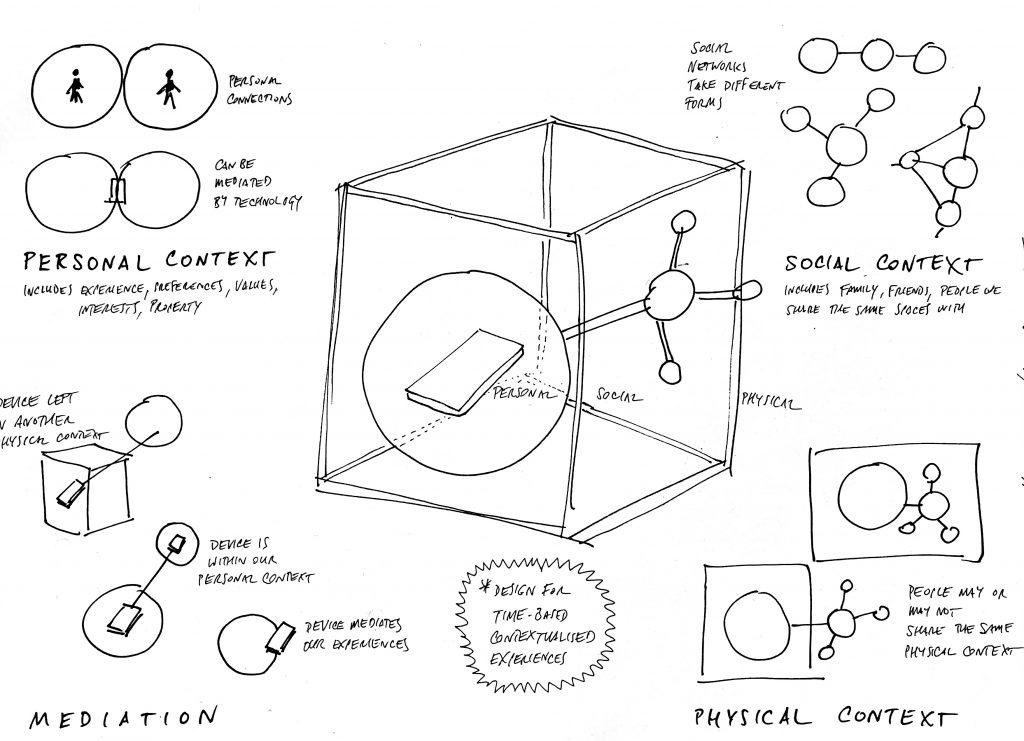
Diagram related to my own PhD research
Photos or video by others might serve as good documentation. A photo of Joseph Beuys running a workshop – an image that has sort of become iconic, taken by one of the participants. Transcripts also (obviously capture different knowledge). Diagrams, mind maps, collectively-edited documents, instructions and how they are enacted on various occasions, toolkits that become documentation/works themselves, eg Fluxus toolkits.
Mapping – for example institutional details that cannot be publicly shared. Practice books: creative/reflective writing. Sometimes the workshop space remains in the exhibition, sometimes with instructions for visitors to add/interact, sometimes just as static documentation, perhaps with diagrams or other artefacts from the workshop/performance.

Photo of Geumhyung Jeong’s exhibition Under Construction at ICA, London
Sometimes practices of documentation change during the course of the thesis – from more to less or vice versa.
‘Practice is messy, is my takeaway,’ one PhD student said.
How does a body of practice ‘stand alone’, particularly if it is documentation of practice that might have been ephemeral? How do theory and practice in the thesis inform each other?
We discussed the use of video: it can be placed on an external website (assuming consent and permissions) or an internal OneDrive site, and referenced in the written thesis. It helps to be selective, to keep examiners/viewers focused, as the thesis should be narrowly focused anyway.
-
This Extraordinary Ordinariness
A film by Hugo Glendinning, with Siobhan Davies, Rosemary Lee and Jonathan Burrows.
This film proposes living archive as a document of contemporary dance methodologies and questions at a moment of rapid change and precarity within the field. Choreographers Siobhan Davies, Rosemary Lee and Jonathan Burrows draw upon long embodied histories of practice to reflect upon what may be lost and what might survive, and how to navigate between necessary innovation and vital lineage of ideas, physicalities and philosophies within the form. The film is both a current record and future resource for contemporary dance scholars and practitioners.
Siobhan Davies has recently created a series of dance works rooted in forms of self-archiving, and in particular Table of Contents (2010) and Transparent (2022). Rosemary Lee is an acknowledged visionary and leader in the field of participatory dance work dealing with landscape and the meeting of body and environment, including Circadian (2019), with 24 dancers of different ages performing the same solo on an empty beach over a 24 hour period. Jonathan Burrows is known for his interdisciplinary work with composer Matteo Fargion, with whom he has recently created the two duets Rewriting (2022) and The Unison Piece (2025). All three artists come from diverse backgrounds and practices, but their conversation reveals the intersections of shared concerns. What does it mean when we talk about the ‘performative’? How does a dance work meet an audience? Modes of attention and the importance of change for how dance connects, communicates and is recognised.
Siobhan Davies, Rosemary Lee and Jonathan Burrows are Associate Professors at the Centre for Dance Research Coventry University, and the film is supported by C-DaRE with the help of Scott deLahunta.

-
Curatorial Training for Cultural Professionals in Cape Verde
This professional development programme focused on the critical role of curatorial practices within museums, fostering professional growth and cross-cultural exchange.
Carolina Rito was guest curator of the curatorial training programme in Cape Verde. Rito organised a week-long programme of workshops, seminars and project development for cultural professionals based in Cape Verde. The focus of the activities centred around the role of curatorial practices in addressing contested memories and histories, and developing critical engagements with various audiences. For a week, the participants had the opportunity to enhance their knowledge about curating, have hands-on experience, and strengthen their professional experience. This programme of activities was organised in collaboration with BLI collective and ZeroPoint Art Gallery. The 12 participants were local practitioners who have prior training or equivalent experience in the cultural field and demonstrate a clear interest in enhancing their curatorial skills.

Photo Credit: Bli Collective, Curatorial Workshop, Mindelo, 2025 
Photo Credit: Bli Collective, Curatorial Workshop, Mindelo, 2025 Cape Verde National news piece: https://youtu.be/2YJq6__LQFA.
LinkedIn news story: https://www.linkedin.com/feed/update/urn:li:activity:7310984419585019905
-
a conversation
14 January 2025
This was an open session for practice research postgraduate researchers in Creative Cultures. At Coventry University Creative Cultures is made up of four research centres: Centre for Postdigital Cultures (CPC), Centre for Dance Research (C-DaRE), Centre for Creative Economies (CCE) and Centre for Arts, Memory and Communities (CAMC).
The practice research postgraduates discussed their work and questions with Simon Ellis from C-DaRE. The conversation was broad and intriguing. We talked about: how the postgraduates’ projects had changed in time; the role of supervisors in their research; the nature of the ‘user experience’ when reading and viewing materials in the final submission; research in which the ‘practice’ is the object of the research (like observing the practices of other people); dealing with technical and technological constraints in presenting research and how that coincides with University regulations; and how the ‘contribution to knowledge’ is the only given in considering how the research is presented.
-
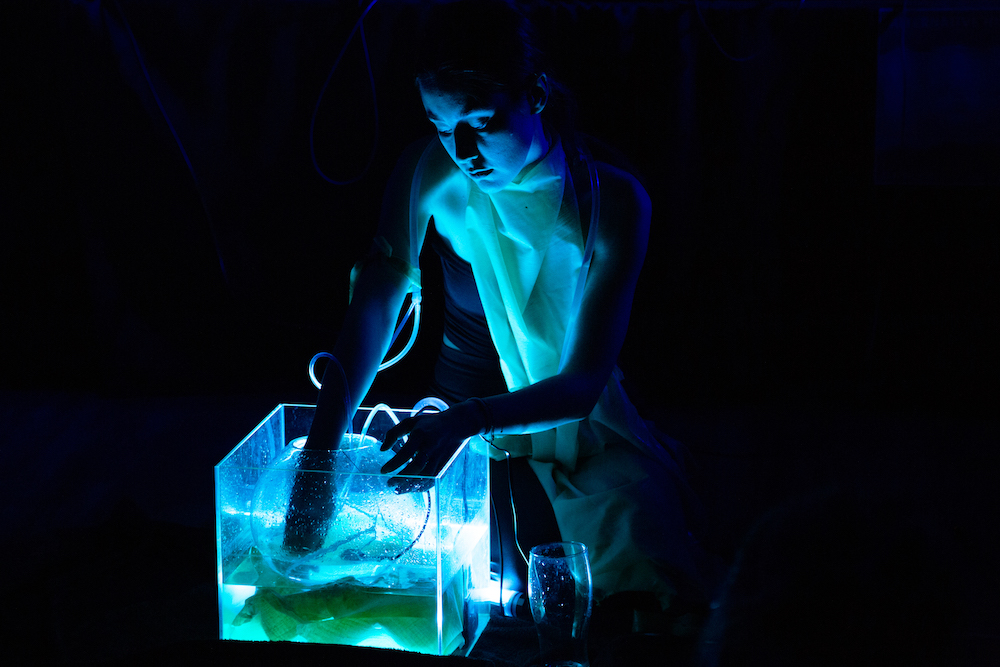
Weavıng Wet Worlds: Buket Yenidogan
This practice-based PhD project is developing a methodology of new media art making specifically using the praxis of hydrofeminist world-ing, in order to explore the impact of transmedia storytelling and collective making on creating cultural change about the climate crisis using emerging technologies. An original methodology of hydro-feminist, posthuman worldbuilding is developed, in addition to a body of new media work. This approach links the flows of migrants and goods across waterways and geographical areas, with flows of water, data and creative energies, as a part of a broad agential assemblage that hydrofeminism figures connected in essence.
Hydrofeminism is a term coined by Astrida Neimanis in her book Hydrofeminism: Or, On Becoming a Body of Water. It refers to the intersection of feminism and the materiality of water, and how water can be used as a metaphor for understanding and reimagining gendered power relations. Neimanis argues that water can be seen as a site of potential transformation, as it is constantly changing and adapting to its environment. Our fluid and porous relationships with our environment beyond dualisms is also discussed within Donna Haraway’s take on the term world-ing in which she implies becoming with the world rather than designing it. Bringing those concepts together, hydrofeminist world-ing is investigated and exercised as a creative methodology of new media art connecting art, technology, science and philosophy.
My current state in this artistic praxis of speculative mythology and technology of an ocean-based culture can be seen at https://www.buketyenidogan.com/